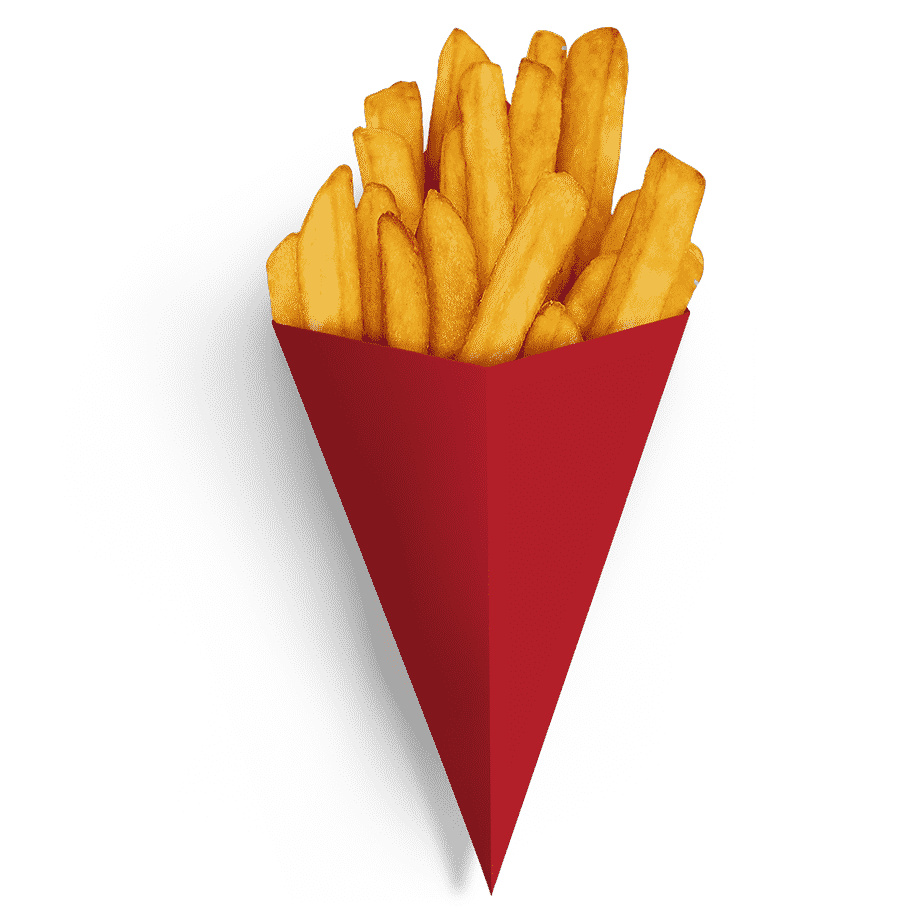
Crispy on delivery

Crispy on Delivery: How to Guarantee Fries That Stay Crunchy on Arrival

Delivery has shifted where food gets judged. A fry is no longer evaluated at the pass. It’s judged when the customer opens the container at home—often 10 to 30 minutes later. That window is where quality perception is won or lost, not at the fryer exit.

Most kitchens nail the cooking. What fails is the holding time imposed by delivery.

Why Soggy Fries Are Structurally the Norm in Delivery

A standard fry was never designed to be confined. The moment you seal it in packaging, three processes start immediately: condensation makes vapor fall back onto the crust and saturate it, moisture migrates from the core to the surface after cooking, and the structure collapses mechanically as the texture gives way.

This isn’t an execution failure tied to operator skill. In the dining room, fries are eaten before this degradation shows up. In delivery, they’re eaten after it’s already happened.

Did you know that?

All Lutosa coating - whether flavoured or not - are gluen-free, i.e. they do not contain wheat or derivatives of wheat. This makes them well-suited for people who suffer from celiac disease and for those who prefer to stick to a gluten-free diet.

A Fry That Loses Crispness in Delivery: A Sensory Detail That Ruins the Whole Meal

The customer doesn’t describe the causes. They deliver the verdict: “the fries are soggy.”

And that one sentence erases everything else. A perfect burger doesn’t redeem a failed fry.

This phenomenon has very concrete business consequences :  

  • Ratings drop on Google, Deliveroo, and Uber Eats,
  • Complaints and compensations rise,
  • Repeat orders decline.,
  • Margins erode through invisible fixes—extra portions, refunds, goodwill gestures.

Crispness isn’t a bonus. It’s a stabilizer for reputation and profitability.

Why Packaging Alone Can't Guarantee Crispy Fries

A vented box doesn’t cancel out a formulation defect. Packaging optimizes a fry designed to last—it doesn’t save a fry that wasn’t engineered for waiting.

Packaging can enhance a suitable fry, but it cannot correct an unsuitable one. The physics of moisture migration start inside the product, not outside it. If the fry structure can’t slow water movement or maintain rigidity, no container design will compensate.

The Only Variable That Changes the Outcome: Product Choice

In delivery, the question isn’t “which fry tastes best at the pass?” It’s “which fry is still crunchy after 20 minutes in transport?”

You don’t choose the same fry depending on whether it’s eaten in the dining room or 15 minutes later in a car, apartment lobby, or hotel room. The use case determines the specification.

Coated fries exist precisely for this difference in usage. They delay moisture penetration, limit crust collapse, and maintain texture beyond immediate service. No standard fry can compensate for this structural gap—not through better cooking, not through better packaging, not through faster delivery.

Hamburger - Our 14-14 ultra-crunchy fries served with hamburger

Why a Long-Holding Fry Becomes Economically Rational Beyond 10 Minutes of Delay

After 10 minutes, the probability of sensory degradation in a standard fry exceeds the tolerance threshold of a paying customer.

Beyond that point, every order shipped with a standard fry is a risk, not a promise.

Satisfaction loss becomes predictable, not accidental.

Hidden costs—complaints, lost loyalty, re-service—exceed the initial purchase savings. Continuing to deliver with a dining-room fry in a delivery model means creating your own quality failure.

The cost structure inverts. The “cheaper” fry becomes the expensive one once you factor in the operational drag it creates downstream.

Why Online Reviews Amplify This Problem

Disappointment with fries is one of the most frequently mentioned irritants in delivery reviews. A complaint about meat stays isolated. A complaint about fries is systematic, reproducible, visible, and contagious.

Two or three negative reviews mentioning “soggy fries” are enough to drop click-through rates on your listing, reduce conversion before orders are even placed, and redirect new customers to competitors. A crispness defect transforms mechanically into future revenue loss, not just present dissatisfaction.

In delivery, crispness functions as an algorithmic variable : poor ratings suppress visibility and suppressed visibility reduces order volume.

It’s not just a food quality issue—it’s a demand-generation issue.

See the Proof in Your Operation

Want to quantify the impact on portions, oil costs, and guest satisfaction in your kitchen?
Contact a Lutosa advisor.

To Keep Fries Crispy on Delivery, The Solution Isn't Better Execution—It's Choosing a Product Built to Last

Lutosa Ultra Crunchy was specifically developed for this use case: measured holding up to 30 minutes after cooking, oil absorption reduction up to 66%, and up to 7% less product needed for the same volume served.

This isn’t just better tasting. It’s more stable, more profitable, and safer from a reputational standpoint.

Why This Product Change Is More Profitable Than Any Other Action

In delivery, crispness isn’t a sensory characteristic. It’s a business variable that governs satisfaction, ratings, and margin.

If the product isn’t aligned with the real consumption delay, the quality failure is structural. You can optimize everything else—packaging, cooking protocols, delivery speed—but if the fry can’t hold, the failure is baked in from the start.

The highest-leverage intervention in a delivery operation isn’t speeding up the driver or redesigning the box. It’s selecting a fry that performs under the conditions that actually exist, not the conditions you wish existed.

Test a Fry That Stays Crispy Up to 30 Minutes

Want to validate holding performance, yield improvement, and oil reduction in your delivery operation?

Contact us

Lutosa UK/Ireland

Subscribe to our  Newsletter

Receive our latest news and projects.

Email